
Anthropic economists Nathan Wilmers, Maxim Massenkoff, and Peter McCrory interviewed people at 58 companies about how they use AI at work. They published the results on November 23, 2026 as Working with AI. The same models produced very different results in different companies. The companies that got the most value changed roles, data access, and review. The companies that only automated one task, or only handed out tools, got less.
This guide sets out what the interviews found, with the real examples from the field. Then it gives an 8-step plan to roll out AI across your company with your team.
Who Was Interviewed
The researchers did 66 interviews with people at 58 Anthropic enterprise customers in the US. They spoke to executives, managers, and individual contributors. The companies ranged from AI-native startups to 100-year-old businesses. They included law firms, hedge funds, private equity firms, manufacturers, a trucking company, dentists, accountants, structural engineers, and a publisher.
The sample was chosen for range across industry, size, and AI use. It is not a random sample, and the value ratings are mostly the interviewees' own judgments. The authors present it as qualitative research for later studies to test. Treat the numbers below as field evidence from serious adopters, and not as national statistics.
All 58 companies are paying Anthropic customers, and the study has no control group. An automated reviewer scored how much each organization changed. Some critics on X dismissed the paper for these reasons.
The interviews covered nearly 300 AI applications. An application is one use case at one company. Each was coded for the value the interviewee gave it and for how much the organization changed to support it.
What AI Is Doing Inside These Companies
The range of work is wide. Agents send faxes between doctors' offices to refer and admit patients. Agents advise technicians when an X-ray machine breaks. Agents read property deeds from the 1800s and plan delivery routes for gaming machines. One agent read a company's organization chart and suggested where to add headcount.
Most of the time, agents write code. Interviewees described 100 pieces of AI-built software in enough detail to classify:
- 80% automated work that people had done by hand, such as spreadsheet financial updates and meeting notes.
- 20% replaced existing software, often a product bought from a vendor.
The apps include tools for private parking enforcement, 401(k) audits, and trademark checks for new product names. Others are dashboards that track portfolio companies, equipment repairs, and calls by debt collectors.
Where the Value Comes From
Most applications added value by raising output. Fewer cut cost. About half of the output gains came from doing existing work faster or in larger volume. The other half came from better quality or new products and services. Three examples from the report:
- A medical group gives patients an up-front estimate of their cost after insurance.
- A commercial real estate manager mocks up vacant units with a prospective tenant's own branding.
- A dental company answers patient calls after hours with an AI service, so midnight calls no longer go to voicemail.
In about one-tenth of applications, employees kept the value. They did more enjoyable work or less work. A construction manager said work "can be a joy again." Some executives were less happy. One said employees hid their AI time savings so they could "walk their dog."
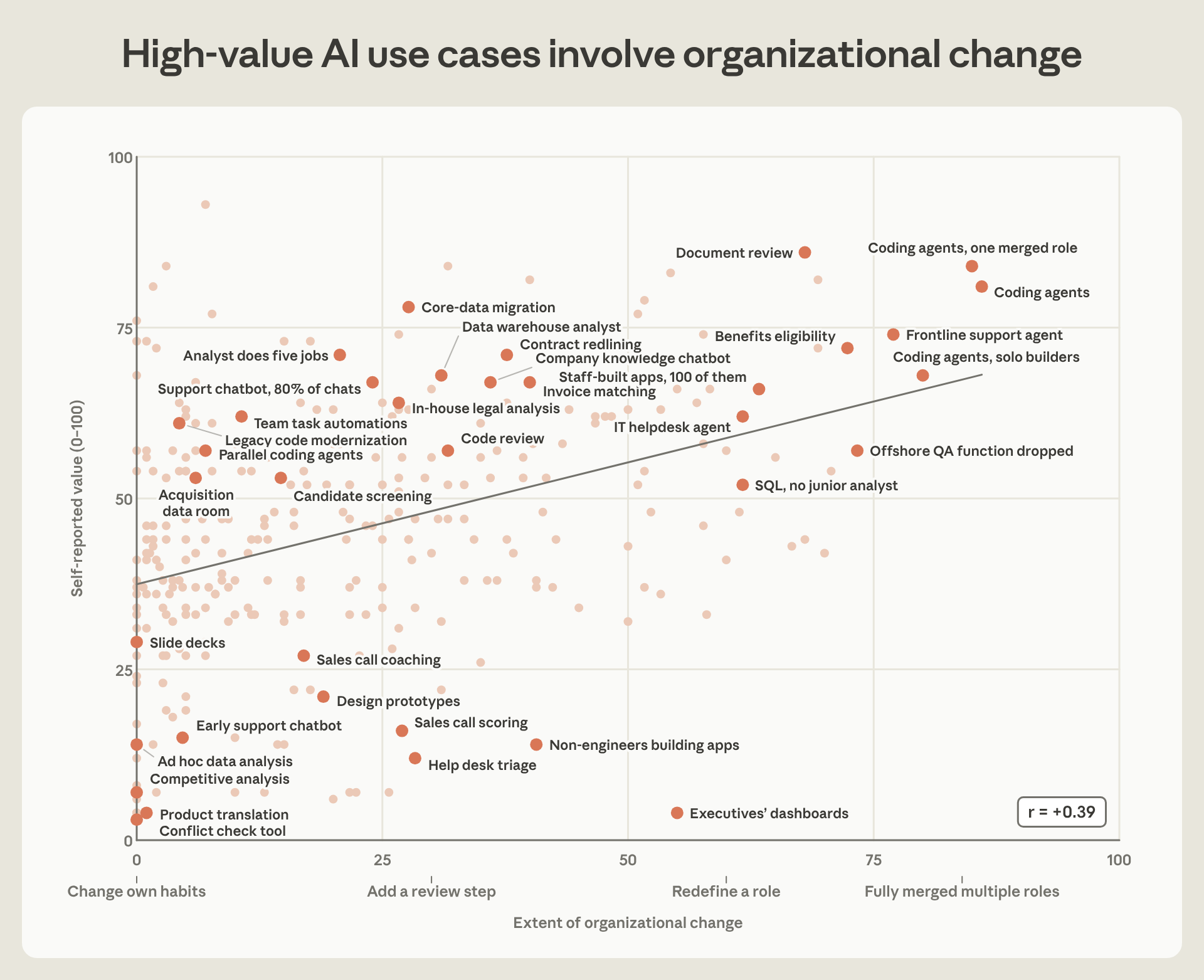
The report plots each application by its value and by how much the organization changed. Slide decks, ad hoc data analysis, and competitive analysis sit at the bottom left. They only asked a person to change habits, and interviewees rated many of them as low value. Document review, benefits eligibility, a frontline support agent, and coding agents sit at the top right. Each one redefined a role or merged several roles.
The link is real but moderate, with a correlation of +0.39. Some uses gave high value with small changes, such as one analyst who now does the work of five jobs. Executives' dashboards changed the organization a lot and gave almost no value.
The high-value uses changed a process, such as AI review of every code commit. Or they changed a role, such as a marketing manager who maintains a brand skill file for AI instead of designing each document.
One accountant called it "a combination of process re-engineering and systematic discipline." The report links this to economic history. In Paul David's study of electrification, factories that only swapped a steam engine for an electric motor gained little. The gains came when they redesigned the factory floor. Later research on the productivity J-curve finds the same lag for general-purpose technologies. We covered the survey data behind this in Why AI Adoption Stalls.
The Gap Between Teams in One Company
Wharton professor Ethan Mollick drew two points from the paper on November 23. The most AI value comes from changing the organization. And worker resistance to AI is wide, partly because of that first point. He added a third point that is not in the paper. Outside of coding, even the most advanced uses that companies try are "not that advanced." He called the capability overhang of AI "very, very large."
In a separate post, Mollick reported what he hears from big firms, from manufacturers to financial services. Scattered teams of 2 or 3 people who use AI do the work of dozens of people in a fraction of the time. Their work often crosses department lines such as marketing, legal, engineering, and sales. This causes "large-scale management fights" over the politics, and "there is no established playbook."
Earlier technology did not split companies this way. A company adopted the cloud in one standard way, so most of its teams got a similar gain. With AI, two teams in the same company can differ in output by an order of magnitude. The team that redesigns its process gets the large gain. The team that adds a tool to the old process gets a small one. Today the gap is largest in coding. As more work runs through software, it will spread to other functions.
The report shows the same split from the inside. Power users and holdouts work in the same teams, and the holdouts carry the costs. One manager said, "In our world, it's like Billy in Sales doesn't trust Sally in Marketing."
What Happened to Jobs
Layoffs caused by AI automation were rare in these interviews:
- 2 companies saw AI automation fully eliminate a position and lead to a job loss.
- 5 companies pushed out employees who would not adopt AI.
- 10 companies hired more because of AI, mostly into AI implementation and IT support.
The larger effect was on hiring. People at two-thirds of the companies said they hired less because of AI. One put it this way: "We may not be firing, but we're not hiring." About a third of these cases were functions that shrank by not replacing people who left. Most were hires the company would have needed to grow, and never made. A health management company said, "We've added a lot of capacity by buying tokens instead of hiring people."
Contract work took the clearest cuts. Nine companies cut contracted developers, support agents, legal counsel, or back-office staff, many already offshore. One finance company cut well over 100 offshore data and developer contractors. A software company said its legal bill "has just completely disappeared" after AI contract review. The authors suggest this may be an early warning for the international business services industry. Work that is split into modular, self-contained tasks is the easiest to hand to an agent.
AI-native startups go further. One COO said 90% of his operations budget goes to AI tokens and 10% to people. Six startups gave an estimate, and on average they said they would need four times as many employees without AI.
For effects on entry-level roles, see When AI Does Junior Work.
Approach 1: Top-Down Automation
In a top-down rollout, leaders pick a workflow, buy or build an automation, and deploy it. This approach drove most of the hiring and contractor cuts. It also showed four repeated problems.
The experts resist. Good agents for expert work need experts to write the instructions and check the output. Those experts know they may be building their own replacement. One employee said, "If I'm open to this, I'm essentially building my own coffin."
A company built an agent to read submissions against its approval policies. It cut planned reviewer hires for the next year by more than 90%. But the current reviewers did not speed up. Some took two minutes per case and others still took more than 10. The company considered gift cards to get them to comply.
The work moves somewhere else. A law firm developer built an agent for conflict-of-interest checks in under a week. Attorneys could ask in plain language. But the agent now surfaced hard conflicts to the conflict staff, which had gone to attorneys before. The staff pushed back. The firm shelved the agent and returned to the old process.
The systems go stale. Many top-down systems came from vendors as fixed industry solutions. Model improvements made them out of date fast. One employee said of such a system, "It'll be obsolete in three months." A customer service scoring system still ran on a two-year-old model, and managers ignored its scores. A law firm ended up with "zombie" apps that almost no one used. One executive described it as throwing "darts at a spinning dart board."
People fear surveillance. Some companies use AI to score employee work. One supervisor checks an AI report on the throughput and error rate of each of 12 people every morning. An executive called the effect a "panopticon." Anthropic's Usage Policy requires that employees be told about such monitoring, and that a human take part in decisions about their performance.
Approach 2: Bottom-Up Experimentation
In a bottom-up rollout, the company gives everyone AI tools and waits to see what they build. This produced some of the best individual stories.
- An accountant with no coding background built an app that audits 401(k) payments across dozens of systems. The audit had taken accountants 80 hours.
- Quality supervisors at a chemical plant built an app to track filtration rates. "They know they're using Python because [Claude] told them."
- An investment manager replaced a $10,000-per-year deal tracker. Another rebuilt a legacy Windows XP app that would have cost $250,000 to replace.
This matches earlier Anthropic research, cited in the report, that nontechnical experts had the highest task success rates with Claude Code.
The problems showed up after the prototype:
- The app stays in one team. A manufacturing employee described "pockets of really cool stuff" with no way to give it to everyone.
- Someone must maintain it. A law firm operations director said a vibe-coded dashboard saves $30 to $100 a month in software, but the talent manager then has to maintain it.
- The last mile stalls. The 401(k) audit app went to an outside vendor to put into production, and months later it was still not in use. An equipment maker turned off AI translation into 10 languages because no one could answer the phone in those languages.
- Power users create work for others. Interviewees described "Claude grenades" and seven-page AI-written instructions sent to IT. One executive said, "A mediocre engineer with an AI is a menace to society."
- Individuals cannot change the process. A hotel services director said, "The individual doesn't have the authority to change the work."
The paralegal in the report, called Mark, shows the human side. He wrote the best AI demand letters at his firm. When the partners asked how, he first refused to share. "That's my secret sauce," he said. Bottom-up adoption alone gives people a reason to keep their methods to themselves.
The Bottlenecks Are Inside the Company
The report lists every bottleneck the interviewees named. Most came from the company itself:
| Bottleneck | Example from the interviews |
|---|---|
| Review cannot keep up | An agent added a stray "S" to an API endpoint and broke a planned feature release |
| Other functions are slower | Code ships fast, but sales, design, and decisions do not keep pace |
| Uneven adoption | Power users and holdouts in the same team, with costs falling on the holdouts |
| Missing data and infrastructure | No shared data, no secure place to host apps built by non-developers |
| Unclear decision rights | A production plan needed sign-off from six functions with no clear owner |
Customer doubt and regulation were rarely named. One executive summed up the pattern: "The closer you are to the money, the harder it is for models to excel in that job." If prototypes are fast but deployment is slow, the company gets much less than the model's benchmark scores suggest.
Approach 3: Reorganize Around AI
The companies with the highest-value results did three things.
Give One Person the Whole Workflow
These companies broadened roles so one person or a small team owns a full workflow. This cuts handoffs, and it cuts the number of people who can block a change. One engineering leader said, "Two people plus Claude is the most amazing thing... if two people agree on something, just ship it."
Examples from the report:
- One company merged lead sourcing, account executive, and customer success into one role that covers the whole customer life cycle.
- Another combined designer, product manager, engineer, QA, and infrastructure into a single role.
- A healthcare startup asks every engineer to talk with the medical staff who use the product.
Broader roles also reduce the fear of job loss. When part of the job is automated, the person still owns the rest. One engineer automated his own production-alert tickets. For two months he read every agent transcript, fixed prompts and integrations, and added missing vendor documents. Six months later he still checked samples every two weeks. The agent grew into a company-wide Slack agent, and "the company basically runs on it now."
Move People to the Bottleneck
When AI speeds up one step, the next step becomes the limit. These companies moved people there. The engineer the report calls Ellen first feared coding agents would end her job. Later she said, "the entire job has switched right from writing code to making decisions."
Examples from the report:
- Construction. An agent now collects morning updates from crews and drafts the daily customer report. Project managers use the time to talk to customers.
- HR services. An agent took over benefits eligibility checks. The team moved to client calls and high-touch support the company could not afford before.
- Consulting. Consultants automated the matching of conflicting standards documents. They moved to more person-to-person consulting work.
- Finance. Certified public accountants grade the output of an AI finance agent.
- Code review. Many engineering teams treated review as the new limit. Some automated it, some gave engineers more review time, and one replaced formal review with developers checking code side by side with Claude.
The largest firms in the study now track employee skills and changes in labor needs in a formal way. Moves like these keep automation from turning into layoffs.
Build Shared Data and a Safe Platform
The most important shared asset was company data. A trucking company built a data warehouse that agents can query. Managers across the company started to run their own analysis. Before, requests went to a queue that took "sometimes a year or two." A trust and safety team used the same kind of access to find fraud patterns in its logs.
This matches Anthropic's September 2025 Economic Index report, which found that more complex business tasks need more context from the user. Agents cannot do complex work on data they cannot reach.
Data access also changes who holds information. At one company, the reporting team asked to block Claude from the data because other people were now producing their reports. The AI advocates won. The reporting team moved from building dashboards to giving advice.
The second asset is a safe platform for non-developers. A data security executive said, "Every single employee now is a developer... creating additional attack surface every day." A real estate company went from 5 developers to dozens of people who want to release software. The companies that handled this built a common place to host apps, with security and maintenance in one place.
An 8-Step Rollout Plan
These steps turn the field lessons into a plan.
- Rank workflows by value. List your AI uses and planned uses. Mark which ones change output, quality, or new revenue. Drop the light-touch uses from the roadmap and let people keep them as personal tools. For each workflow you keep, agree with the business on one KPI: time, revenue minus token cost, or risk. Our readiness scorecard helps with this.
- Pick whole workflows and name one owner. Choose 2 or 3 workflows end to end, from request to result. Give each one an owner with the authority to change the steps. Write down who decides at each step, before any agent is built. Get an executive sponsor who can drop steps, merge teams, and change KPIs. Without one, the team can only automate the old process.
- Map the real process and cut steps. Map each step and each exception. The written procedure and the system logs often differ, so read both. Then redesign. A 15-step process can often become 5 steps, with AI doing 4 of them.
- Bring the experts in as designers. Ask the people who do the work today to write the rules and the test cases. Tell them in writing what their role will be after launch. This removes the "building my own coffin" problem.
- Get the data ready. Connect the systems each workflow needs, with permissions that match each user's role. Build agents that work inside the systems people already use, such as SAP, Salesforce, or ServiceNow. Log every agent action. A shared data layer serves agents and employees at the same time.
- Plan review capacity first. Estimate the volume the agent will produce and who will check it. Build an evaluation set from past cases, so a person reviews exceptions and not every item. See who signs for the AI's work.
- Plan where people go. For each workflow, write down the tasks that move to AI and the new tasks people take on. The people who run the new process own its agents. They handle the exceptions and improve the agents over time. Train people for these new tasks. Use our human rollout plan as a template.
- Revisit every quarter. Re-test each agent when a new model ships. Look for the next bottleneck. Retire apps that no one uses. Share the gains with the team, because the people who see a benefit are the ones who bring their methods forward.
How OpenNash Helps
OpenNash puts forward-deployed engineers inside your team. We work with Fortune 2000 companies to do the reorganization work that the interviews show creates the most value. We work beside your experts, so the knowledge stays in your company.
- Workflow and value review. We interview your teams, map the workflows, and show which ones give the highest business value and the fastest ROI.
- Ownership and decision rights. We help you name the owner of each workflow and write down who approves what.
- Expert capture. We sit with your best people and turn their methods into rules, prompts, and test cases.
- Data and systems. We get your data ready and connect your ERP, CRM, document systems, and data warehouse with role-based permissions and audit logs.
- Production agents with review built in. We build the evaluation set first, then ship agents with approval points, cost controls, and full audit trails.
- A platform for your builders. We give your non-developers a safe place to build and host internal apps, so good ideas spread past one team.
- Training and handover. We train your people to run, check, and improve the agents, and we help you plan new roles for the people whose tasks change. You own everything we build.
See how this works for professional services, PE portfolios, healthcare operations, and other industries.
Book a call with an OpenNash forward-deployed engineer, or email hello@opennash.com. We will review your top workflows with you and show where to start.