Realize the potential of open and safe AI for every enterprise.
Our forward-deployed engineers do three things inside your business:
Build custom AI agents and AI platforms on your data
Modernize legacy systems that have no API
Run security agents 24/7
Any model, any environment: cloud, on-premises or air-gapped. Built on what you already run.Starting from zero? We bring an open-source stack you own, and run it for you if you want.
Each one runs in production, measured in cost and hours saved.
01OpenNashWorkMultiplayer AI for productivity.Every enterprise's hardest AI problem is governed access to data. AI agents are only as good as the context they have. We build reusable MCP servers over your systems, scoped to each user and audited.
02OpenNashFDE AgentsCustom AI agents for business operations.Agents that take whole processes off your team's plate, measured in hours saved and cost per case. Our engineers learn how your best people do the work, then build, test and run the agent.
03OpenNashSoftware FactoryLegacy systems, modernized safely.Old systems with no API block your AI and cost the most to run. We open them up with APIs, then replace them piece by piece, without disrupting the business.
04OpenNashSecurity24/7 threat detection and response.Attacks now move at machine speed. Our agents defend you 24/7: they detect, investigate and respond to threats, and patch new CVEs within hours.
Have a stack?We build on it.ChatGPT, Copilot, Claude or Gemini, your cloud and your systems of record. We plug in; we don't rip and replace.
Starting from zero?We bring ours.An open-source stack, customized for your systems, data, models and rules, then built and managed for you.
Either wayYou own it.Your cloud or on-prem. The code, prompts, evals and data are yours. Run it yourself, or have us operate, patch and upgrade it, and take it in-house anytime.
Legacy accessMainframe green screens, on-prem ERPs, vendor portals and 20-year-old PHP, .NET or Java apps with no API. We start read-only: agents document the codebase so your team can understand it again, and we add a read-only API layer over the database or service, so agents can look things up without touching production. Writes come later, behind approval gates. Where there is no safe way in, browser automation drives the screens like an operator, with retries, screenshots and an audit trail for every action.
Works with your stack
AI you already use
Cloud AI platforms
Open models, your hardware
Systems we connect to
… 1,000+ more, and your internal tools
Legacy systems, no API needed
SalesforceAgents read and update accounts, opportunities and cases, draft follow-ups, and keep the pipeline clean, with every write logged.
What you get
Measured against your own test cases
Cost per task you can see
New CVEs matched within hours
Code, prompts and data you own
About OpenNash
A typical enterprise. The knowledge an AI agent needs is spread across dozens of systems, some with no API, many with their own permissions, and all of it resting on code few people still understand. An OpenNash drawing, inspired by xkcd 2347 “Dependency”.
People stop chasing colleagues and reports. Agents in Slack or Teams answer from governed company data in seconds, with each person's own permissions.
What we measure
Adoption
Weekly active users per team
Speed
Time to answer a data question
Value
Hours saved per team, per week
Outcome.02 / FDE Agents
10x
Lower cost per case
Routine processing in support, operations, finance and compliance moves to agents. People handle the exceptions and the judgment calls.
What we measure
Cost
Cost per case, before and after
Speed
Cycle time, intake to done
Quality
Exception and error rate
Outcome.03 / Software Factory
10x
Engineering throughput
Migrations, upgrades and test coverage that would take quarters move in weeks, with every change verified before it merges.
What we measure
Throughput
Verified pull requests merged
Safety
Test coverage on changed code
Legacy
Modules documented and modernized
Outcome.04 / Security
24/7
Hours, not weeks, to patch
New CVEs are matched to what you run within hours, patches are staged and tested, and logs are reviewed around the clock.
What we measure
Exposure
Time from CVE to patch
Response
Time to detect and contain
Backlog
Open critical vulnerabilities
People, process, technology.
We work side by side with your subject-matter experts on the hardest problems in your business. We are not after a small gain on an existing process. We aim for a step change in how the work gets done.
We start by finding what slows your people down, what they would hand off if they could, and where revenue is quietly leaking.
Example: a four-step process
1Collect the documents and dataAgent
2Check them against your rulesAgent
3Draft the decision or outputAgent
4Review and sign offYour expert
Steps 1 to 3 run automatically. Your expert keeps step 4: reviewing the result and signing off before anything goes out. Their time goes to judgment, not to assembling the work.
Technology
Automation.
We build, test and run agents that take over job functions and repetitive workflows. OpenNash CX covers the customer-facing channels.
WorkAI coworkers connected to your company's data.
FDE AgentsCustom agents that take over business processes.
Software FactoryLegacy systems opened up with APIs and modernized safely.
SecurityAgents that watch, investigate and respond around the clock.
You ownAll of it
People
Education.
Our AI 101 and 201 sessions get executives and teams productive with AI tools quickly, on their own work.
AI 101Prompting, private context, and moving beyond chat.
AI 201Agents, memory, tools, approvals, and running real workflows.
ExecutivesA personal setup with Claude Code, Codex, Hermes and OpenClaw, connected to your calendar, email and docs.
ForExecutives and teams
Process
Change management.
Agents are not perfect. We agree with you how they work alongside your people and how they safely reach your core systems, then keep improving them.
OwnershipWho reviews outputs, who handles exceptions, who approves changes.
Weekly reviewWhat worked, what failed, and what the agent learns next.
PlaybookPlain-language instructions for using the agent, checking its work and improving the process.
ReviewWeekly
Your first deployment, week by week
Week 01Embed
Sit with your experts.
We work with the people who own the process. By the end of the week, scope is locked and the test cases that prove it works are signed off.
interviews · ride-alongs · test cases
Week 02Build
A first version, end to end.
It runs on representative data, with daily demos against the agreed test cases.
daily demos · test-case gate
Week 03Harden
Make it production-grade.
Real integrations, sign-in through your identity provider, error handling, monitoring and audit logs.
SSO · audit logs · live data
Weeks 04-08Live
In production. Then the next one.
We keep operating it with your team, and once it is stable we take on the next workflow, codebase or system.
in production · training · what's next
What you get: running in production on your systems, test cases every change must pass, an audit log and dashboard, and a runbook. All of it is yours, so your team can run it without us. We start with one workflow, then take on the next one.
How we keep agents safe.
Ctrl.01
Encrypted, never trained on, versioned
Encrypted in transit and at rest, never used for training, with zero data retention where the model provider offers it. Kept only as long as your policy allows, and every prompt and workflow can be rolled back.
Ctrl.02
Your environment
Isolated per customer, in your cloud or fully on-prem.
Ctrl.03
Human approval gates
High-risk actions never run on their own; each has a named reviewer.
Ctrl.04
Recovery paths
Every known failure has a retry, a fallback or a human escalation.
Ctrl.05
Evals in CI/CD
Online and offline evaluations catch regressions before production.
Ctrl.06
Audit logs, least privilege
Every read, write and tool call logged and exportable. SSO and RBAC on every agent.
Four ways to work with OpenNash.
01 / WorkAI for people
OpenNash Work
Multiplayer AI for productivity
Buying seats is the easy part. AI only becomes useful when it can safely reach the data and systems your teams work in, and when whole teams, not just individuals, work with it. Our engineers come from both data engineering and AI, so they can do that connecting work and get it through your security review.
With or without an enterprise AI rollout: if you already have ChatGPT Enterprise, Microsoft Copilot, Claude and Cowork, or Gemini Enterprise, we connect it to your data. If you have none of them, we build custom agents from scratch on the models you choose, including self-hosted ones.
Multiplayer agents: custom agents your teams call from Slack or Microsoft Teams, shared across a channel, with every action visible to the people involved.
Secure access to your systems: read-only access to databases, warehouses and business systems first, through reusable MCP tools with enterprise authentication. Agents act on behalf of each user, with that user's permissions and your control policies.
Security reviews handled: we bring the architecture, data-flow and access documentation your security and compliance teams need, and work through their questions with them.
Data that agents can use: data models and pipelines on your modern data stack (Snowflake, Databricks, dbt and the like), so "revenue" means one thing to every person and agent.
Shared skills for recurring work: board packs, RFP responses, research memos, month-end commentary.
02 / FDE AgentsAI for processes
OpenNash FDE Agents
Custom agents, built and run for your processes
Our engineers sit with the team that owns a process, learn how your best people actually do it, and ship an agent that runs it end to end, with humans approving the exceptions.
Typical first workflows: claims and intake, invoice exceptions, KYC and onboarding, customer rebookings and refunds, renewals.
Evals written from your real cases, so "working" is measured, not demoed.
Wired into your systems of record, including the ones with no API (see the AI Foundation).
We keep operating it after launch: monitoring, fixing failure modes, then the next workflow. Voice, chat and email run on OpenNash CX.
03 / Software FactoryAI for legacy systems
OpenNash Software Factory
Legacy systems modernized, safely and step by step
Most enterprises run critical systems that nobody fully understands: a COBOL batch job, a PHP billing app, a .NET service whose author left in 2014. They have no API, so AI cannot use them, and they are expensive and risky to change. We open them up first, then modernize them one piece at a time. The old system keeps running until the new one has proven itself.
Open them up: an API over the old system, so your AI agents, dashboards and new apps can use its data within weeks.
Know what you run: a plain-language map of each system: what it does, the business rules inside it, and who depends on it.
Change without risk: old and new run side by side on real work. We switch over only when the results match, and the rules that move money are proven correct.
Cut cost: retire mainframe and license costs, end manual re-keying, and move COBOL, PHP, Java and .NET to supported platforms.
Your rules: your team approves every change through your own review process, on Codex, Claude Code, GitHub Copilot or open-source agents.
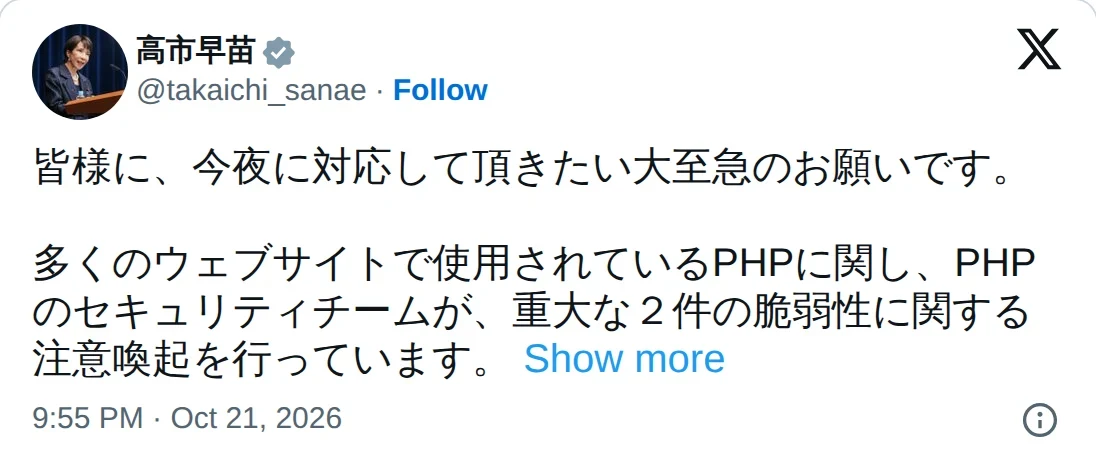
October 2026 · PHP2ShellPHP runs about 70% of websites. Two remote-code-execution flaws in PHP itself (CVE-2026-109618 and CVE-2026-109619, CVSS 9.2) were exploited before the patch shipped, and Japan's Prime Minister asked website operators to patch that same night or take their sites offline.
Prime Minister Sanae Takaichi on X, 21 Oct 2026, 9:55 PM JST: "An urgent request for everyone to act on tonight. The PHP security team has issued a warning about two serious vulnerabilities in PHP, which is used by many websites."
Breaches like this will come faster. AI is speeding up how fast flaws are found and how fast they are exploited, and most companies cannot list every server running PHP in one evening, let alone patch them all overnight. Business continuity now depends on defence that runs 24/7: agents that watch, patch and respond while your team sleeps.
Keep a live inventory of every system, version and dependency you run.
Match new CVEs against that inventory within hours, then open, test and stage the patch or upgrade.
Review logs around the clock for signs of compromise, and escalate to your team with the evidence attached.
Govern your own AI agents too: identity, least-privilege permissions, audit logs and red teaming before production.
Looking for examples in your industry?
Explore healthcare, finance, legal, insurance, CX, GTM, and operations workflows.
Inbound voice, SMS, email, and web chat handled around the clock. Books to your calendar, updates your CRM, and escalates the cases that need a human, with full transcripts and audit logs.
ChannelsVoice / SMS / Email / Web chat
Coverage24/7 intake and follow-up
IntegrationsCRM / calendar / ticketing / billing
Human handoffAlways on, fully audited
Included whenThe workflow touches customer-facing channels
1,000+ native integrations, and an API layer for the systems that have none.
CRM & Pipeline
Finance & ERP
Support & Helpdesk
Vertical Systems
Docs & Comms
Voice & LLMs
Salesforce
SAP
Snowflake
Databricks
Google Cloud
Stripe
HubSpot
Shopify
Salesforce
SAP
Snowflake
Databricks
Google Cloud
Stripe
HubSpot
Shopify
Jira
GitHub
Notion
Asana
Zoom
Zendesk
Linear
Figma
Discord
Jira
GitHub
Notion
Asana
Zoom
Zendesk
Linear
Figma
Discord
PostgreSQL
MongoDB
Redis
MySQL
Airtable
Supabase
Mailchimp
Intercom
Dropbox
Google Drive
Gmail
Calendly
PostgreSQL
MongoDB
Redis
MySQL
Airtable
Supabase
Mailchimp
Intercom
Dropbox
Google Drive
Gmail
Calendly
Pricing
Simple. Transparent.
No long-term contracts. No per-seat pricing. No consulting hours. One active workflow at a time, then move to the next once it is stable. Cancel or pause anytime. A flat fee gives you the cost predictability of a full-time employee.
One price model, every offeringWork, FDE Agents, Software Factory and Security all run on the same flat monthly fee.
Standard/ month to month
Pricing.
Put one workflow, team or codebase into production with measurable revenue, cost, or time savings.
Flat fee/ month
Any offering: Work, FDE Agents, Software Factory or Security
One active workflow at a time; swap once stable
Live in production in 4-8 weeks
48-hour turnaround on in-scope requests
Ongoing support and maintenance included
Human review, exception handling, dashboard, audit logs, test cases, and playbook included
Weekly iteration and failure-mode patching included; no per-fix billing
OpenNash CX deployed when the workflow involves customer-facing channels
Practical AI education for your team
In person when it matters: wherever you are, we fly out on our dime
Your stackYour AI platform, APIs, CRMs, warehouses and browser-only portals, or open source you own.
TermMonth to month. No annual lock-in.
Common questions
Frequently asked.
If you have been burned by AI consultants or agencies before, this is where you find out why OpenNash is different.
Want everyone in the company using AI? Start with Work. A complex business process to automate? FDE Agents. A backlog, migration or legacy codebase? Software Factory. Worried about the next critical vulnerability, or about the agents you already run? Security. Not sure where to start? FDE Agents, beginning with discovery. Most clients mix and match.
Yes to both. We are vendor-neutral and build on whatever you run: the AI you already license (ChatGPT Enterprise, Microsoft Copilot, Claude and Cowork, Gemini Enterprise, Codex, Claude Code, GitHub Copilot), any model provider or open-weight model, any cloud or on-prem environment, your systems of record (Salesforce, SAP, Oracle, Microsoft 365, Snowflake, Databricks and 1,000+ more), and legacy software with no API at all. If you have nothing yet, or your data must stay in-house, we build an open-source stack with open-weight models on your cloud or fully on-prem. You own the code. Run it yourself, or we manage it for you.
Most agents go from intake to a working first version in about two weeks and live production use in 4-8 weeks, depending on workflow complexity, integrations, and approval cycles. In-scope requests and fixes move on a 48-hour turnaround while the active workflow is being made production-ready. The main delays usually come from enterprise change management: data access, security review, legal review, and internal approvals.
Week one is the audit. We embed with the function that owns the workflow, interview the people doing the work, and lock scope. You do not need to prepare a deck. You need the people, the tools, and access.
One active workflow at a time. That keeps scope tight and quality high. Once the agent is stable in production, we can swap in the next workflow or keep improving the current one. New workflows are scoped before they become active.
Pause between workflows and resume when you are ready for the next build. Anything we already shipped remains yours and keeps running in your existing software.
Bigger workflows ship as a series of small production slices. We do not scope twelve-month transformation programs. We ship one production workflow at a time and build from there.
Revisions are included for the active workflow. If a deliverable misses the agreed test cases, we rebuild it at no extra cost.
Included for the active workflow. Every system we deploy is monitored, tested weekly, and updated as your tools change. Failure modes are patched without per-fix billing.
Yes. 100%. Your data, prompts, workflows, dashboards, test cases, and integrations are yours. If you stop, you keep everything and can hand it to any team to run.
Education is one of the three pillars in the monthly plan. We include regular practical AI education, covering AI 101/201 material, executive AI stacks, and hands-on training on the systems we deploy. The agent only compounds if your people can prompt, review, and improve it.